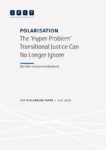

As a 'hyper-problem' that makes political and social challenges harder to resolve, polarisation is both a barrier to addressing a violative past and a leading indicator of future risks of conflict and violence. Polarisation can decrease social cohesion, contribute to a culture of violence and impunity, and eventually incite mass atrocity, making it a pressing concern for transitional justice – a field designed to address such violations. Yet, transitional justice actors have largely, and dangerously, ignored polarisation to date.
This discussion paper, co-authored by CSVR Senior Research Specialist Jasmina Brankovic, compares transitional justice and depolarisation, identifying correlations between their respective objectives and tools. It examines ways in which transitional justice and polarisation act as mutual risk multipliers, creating negative feedback loops that produce additional harms and make future attempts at transition more difficult.
The paper proposes backward-, present- and future-looking approaches for ensuring transitional justice interventions account for polarisation, ranging from technological tools to narrative interventions and policy changes. It provides a conceptual framework for thinking about this critical but underexamined relationship, opening the door for polarisation-sensitive transitional justice.
IFIT-Polarisation-The-Hyper-Problem-Transitional-Justice-Can-No-Longer-Ignore-Slye-and-Brankovic-2025

Dr. Jasmina Brankovic is Senior Research Adviser at the Centre for the Study of Violence and Reconciliation. With a focus on participatory methods, Jasmina conducts research on inequality and socioeconomic transformation, climate justice, narrative change, and civil society strategies in transitional contexts. Her publications include 'Violence, Inequality and Transformation: Apartheid Survivors on South Africa's Ongoing Transition' (2020), 'The Global Climate Regime and Transitional Justice' (2018) and 'Advocating Transitional Justice in Africa: The Role of Civil Society' (2018). She has a PhD in Political Science from the University of Marburg (Centre for Conflict Studies).